United States Pavilion
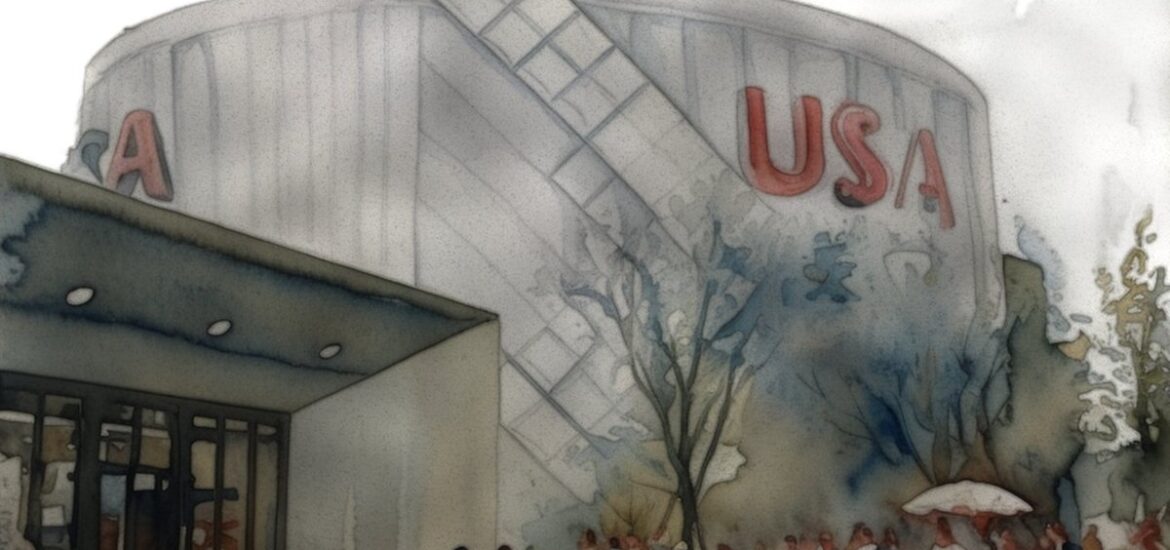
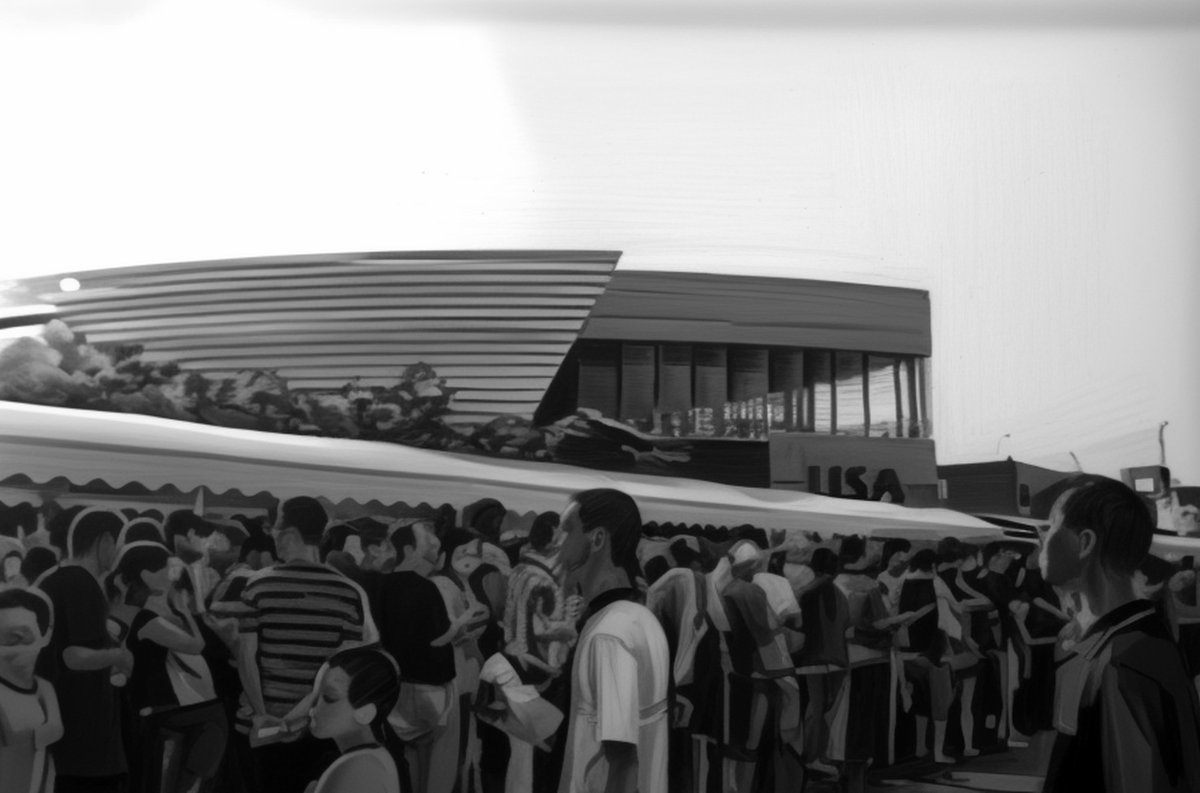
The United States Pavilion was not a delicate thing. Designed for the 1964 New York World’s Fair and themed to the “challenge to greatness,” it read from the fairground as a boxy slab held in the air — what The New York Times called “a rectangle on a squat pyramid,” and a Progressive Architecture guidebook less kindly likened to “a gigantic ice-cream sandwich” with a blue and green plastic filling.
A hollow square on stilts
In plan the building was a hollow square, 330 feet on each side, wrapped around an open-air garden court. It stood 84 feet tall — roughly an eight-and-a-half-story building — lifted on four stilts measuring 18 feet high, one at each corner of the court. From those corner supports the structure was cantilevered fully 75 feet inward, a span the Christian Science Monitor reported was “believed to be the largest building cantilever project ever erected.”
Engineering and materials. The primary architect was Leon Deller of Charles Luckman Associates; Severud-Elstad-Krueger served as structural engineer, with steel supplied by Bethlehem Steel. The building sat on 2,300 pilings — originally specified as temporary wood, later changed to steel and concrete — and officials claimed it could stand for a century. The inner walls were carried on trusses 182 feet long and 57 feet high, paired along both the inner and outer faces. The translucent facade was cast in plastic panels of varied greens and blues, reflecting sunlight by day and lit from within at night.
Approach and water
Visitors crossed a moat with fountains, spanned by four bridges, then climbed pyramidal staircases — the largest on the fairground, 72 steps in four flights, narrowing to four feet at their tops. The route delivered them into the garden court, which Luckman intended to give an “atmosphere of peaceful relief,” and which carried Archibald MacLeish’s line: “The American Journey has not yet ended. America is never accomplished. America is always to build.”
Afterlife
The pavilion drew 5.5 million visitors in 1964 and won an American Institute of Steel Construction award the same year. Meant to be permanent, it was instead abandoned, vandalized, and — after years of failed preservation bids — razed in 1977. Arthur Ashe Stadium opened on its site in 1996.
United States