
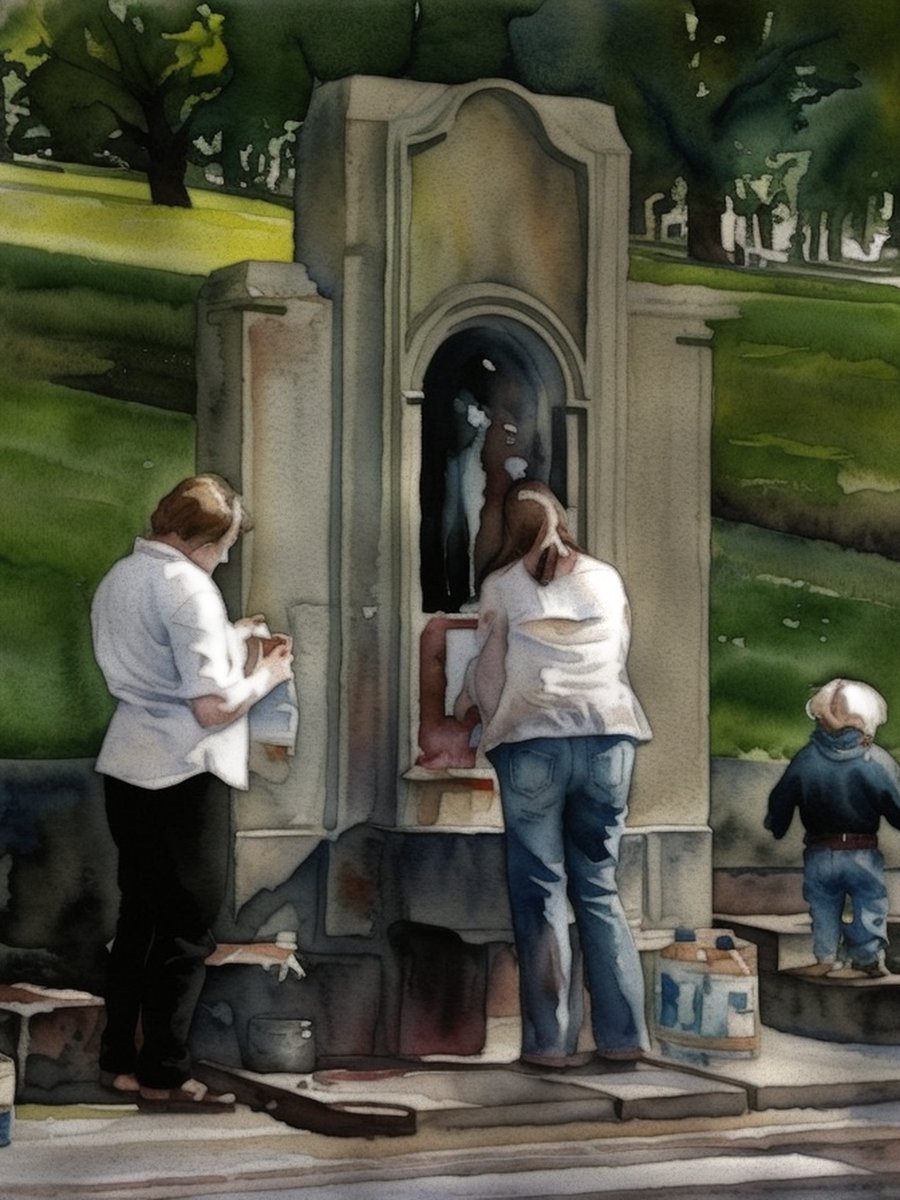
A spring at the foot of the slope
St Ann’s Well sits at the foot of The Slopes — formerly St Ann’s Cliff — in Buxton, Derbyshire, facing the Crescent hotel and the Old Hall Hotel across the way. The siting is the whole point: this is a natural warm spring, geothermal water rising from roughly half a mile below ground, emerging at a steady 27 °C and flowing at about a quarter of a million gallons a day. The architecture here has always been an act of framing rather than invention — building over water that was already sacred.
Materials and the current structure
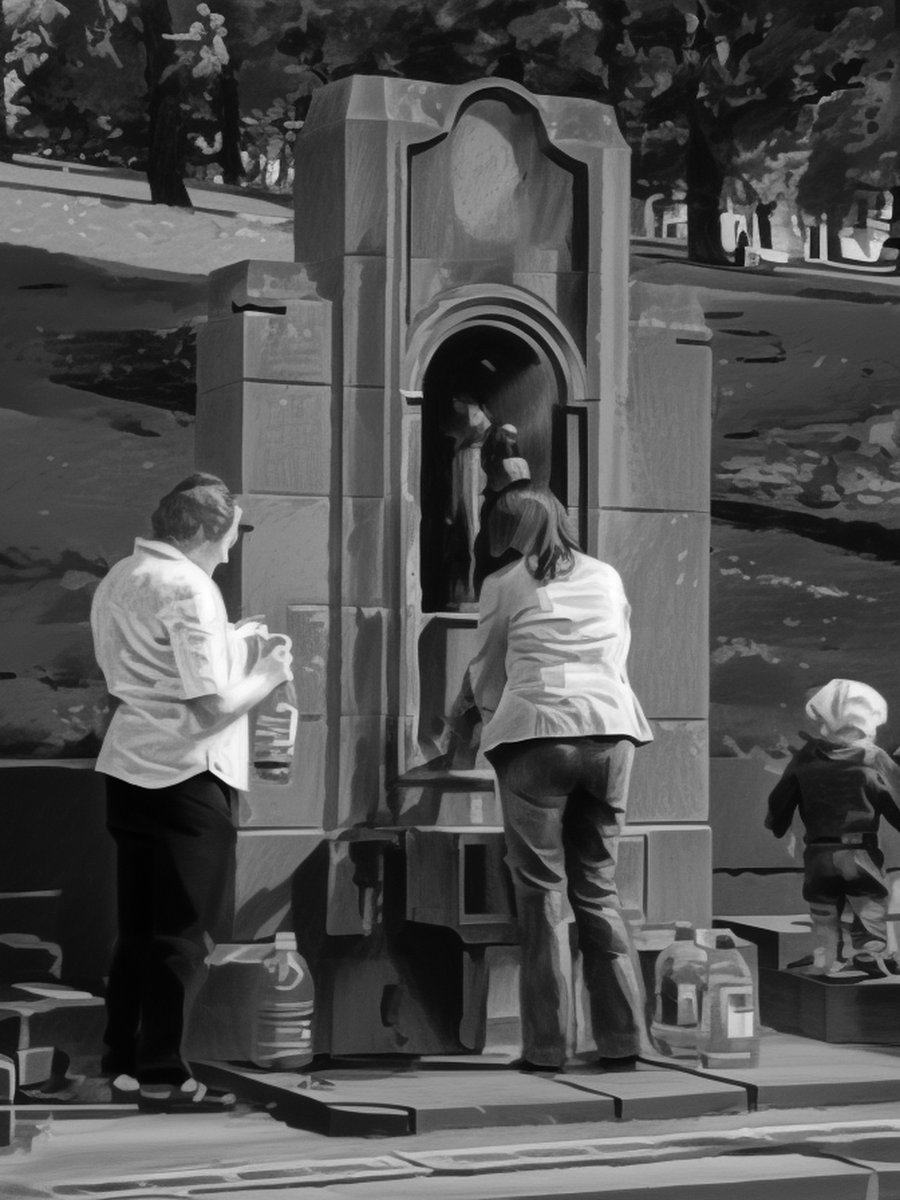
The fountain you read today was built in 1940 and is a Grade II listed structure. It is worked in ashlar gritstone, with a brass lion’s head spout pouring into a marble trough — a tight, legible palette of dressed local stone, polished brass and cool marble. A bronze statue of St Ann and child, by the English sculptor Herbert William Palliser (1883–1963), presides over it, and the inscription commemorates Councillor Emelie Dorothy Bounds. The result is restrained civic classicism, dignifying a public tap.
Layers of stewardship
The well has been continuously re-housed. By the 1520s the spring was dedicated to St Anne, and a 16th-century Act of Parliament required free water for the town’s residents. In 1709 Sir Thomas Delves built an arch over the spring in thanks for his recovery, with seating on all sides. Architect John Carr designed the 1783 drinking well to satisfy the Buxton Inclosure Act of 1772; Henry Currey designed the 1852 well and the 1894 Pump Room — a gift of the 8th Duke of Devonshire to safeguard free access. Each layer reads as masonry wrapped protectively around the same flow.
Water, coins and ritual
The wishing tradition here is genuinely deep. When the main spring was excavated in the 1970s, a hoard of 232 Roman coins was found, spanning 300 years of occupation — offerings cast into the sacred waters to seek the favour of the gods, alongside bronze jewellery now in the Buxton Museum. The medicinal cult endured: William Worcester wrote of its miracles in the 1460s, and Mary, Queen of Scots came most years from 1573 to 1584 to “take the cure.” The Victorian revival of Derbyshire well dressing continues that devotion to the water itself.
High Peak, United Kingdom